Interactive acoustic auralization allows users to explore virtual acoustic environments in real-time, enabling the acoustic recreation of concert hall or Historical Worship Spaces (HWS) that are either no longer accessible, acoustically altered, or impractical to visit. Interactive acoustic synthesis requires real-time convolution of input signals with a set of synthesis filters that model the space-time acoustic response of the space. The acoustics in concert halls and HWS are both characterized by a long reverberation time, resulting in synthesis filters containing many filter taps. As a result, the convolution process can be computationally demanding, introducing significant latency that limits the real-time interactivity of the auralization system. In this paper, the implementation of a real-time multichannel loudspeaker-based auralization system is presented. This system is capable of synthesizing the acoustics of highly reverberant spaces in real-time using GPU-acceleration. A comparison between traditional CPU-based convolution and GPU-accelerated convolution is presented, showing that the latter can achieve real-time performance with significantly lower latency. Additionally, the system integrates acoustic synthesis with acoustic feedback cancellation on the GPU, creating a unified loudspeaker-based auralization framework that minimizes processing latency.
@article{rosseel2026accelerated,title={Accelerated Interactive Auralization of Highly Reverberant Spaces using Graphics Hardware},author={Rosseel, Hannes and {van Waterschoot}, Toon},year={2026},journal={Journal of the Audio Engineering Society},volume={74},number={6},pages={445-455},}
2025
journal
A State-of-the-Art Review on Acoustic Preservation of Historical Worship Spaces through Auralization
Historical Worship Spaces (HWS) are significant architectural landmarks which hold both cultural and spiritual value. The acoustic properties of these spaces play a crucial role in historical and contemporary religious liturgies, rituals, and ceremonies, as well as in the performance of sacred music. However, the original acoustic characteristics of these spaces are often at risk due to repurposing, renovations, natural disasters, or deterioration over time. This paper presents a comprehensive review of the current state of research on the acquisition, analysis, and synthesis of acoustics, with a focus on HWS. An example case study of the Nassau chapel in Brussels, Belgium, is presented to demonstrate the application of these techniques for the preservation and auralization of historical worship space acoustics. The paper concludes with a discussion of the challenges and opportunities in the field, and outlines future research directions.
@article{rosseel2025state,title={A State-of-the-Art Review on Acoustic Preservation of Historical Worship Spaces through Auralization},author={Rosseel, Hannes and {van Waterschoot}, Toon},year={2025},journal={Signal Processing},volume={234},pages={109992},issn={0165-1684},doi={10.1016/j.sigpro.2025.109992},keywords={Acoustic preservation,Auralization,Historical worship spaces,Room acoustics}}
journal
On Time Delay Interpolation for Improved Acoustic Reflector Localization
The localization of acoustic reflectors is a fundamental component in various applications, including room acoustics analysis, sound source localization, and acoustic scene analysis. Time delay estimation (TDE) is essential for determining the position of reflectors relative to a sensor array. Traditional TDE algorithms generally yield time delays that are integer multiples of the operating sampling period, potentially lacking sufficient time resolution. To achieve subsample TDE accuracy, various interpolation methods, including parabolic, Gaussian, frequency, and sinc interpolation, have been proposed. This paper presents a comprehensive study on time delay interpolation to achieve subsample accuracy for acoustic reflector localization in reverberant conditions. We derive the Whittaker-Shannon interpolation formula from the previously proposed sinc interpolation in the context of short-time windowed TDE for acoustic reflector localization. Simulations show that sinc and Whittaker-Shannon interpolation outperform existing methods in terms of time delay error and positional error for critically sampled and band limited reflections. Performance is evaluated on real-world measurements from the MYRiAD dataset, showing that sinc and Whittaker-Shannon interpolation consistently provide reliable performance across different sensor-source pairs and loudspeaker positions. These results can enhance the precision of acoustic reflector localization systems, vital for applications, such as room acoustics analysis, sound source localization, and acoustic scene analysis.
@article{rosseel2025time,title={On Time Delay Interpolation for Improved Acoustic Reflector Localization},author={Rosseel, Hannes and {van Waterschoot}, Toon},journal={The Journal of the Acoustical Society of America},year={2025},pages={2795-2812},volume={158},number={4},doi={10.1121/10.0039541}}
phdthesis
Spatial Recording, Processing, and Auralization of Historical Worship Space Acoustics
This PhD research aims to design, implement and evaluate a methodology for the recording, processing and auralization of historical worship space acoustics. A comprehensive review of the state-of-the-art methods that enable acoustic auralization in historical worship spaces will be carried out. Signal processing algorithms for the spatial analysis, modelling, and synthesis of historical worship space acoustics will be designed, and a loudspeaker-array auralization framework will be developed that allows for real-time and interactive auralization. Perceptual experiments with plainchant performers will be carried out to evaluate and calibrate the proposed methods.
@phdthesis{rosseel2025spatial,title={Spatial Recording, Processing, and Auralization of Historical Worship Space Acoustics},year={2025},school={KU Leuven},url={https://lirias.kuleuven.be/4245435},author={Rosseel, Hannes and {van Waterschoot}, Toon}}
2024
conference
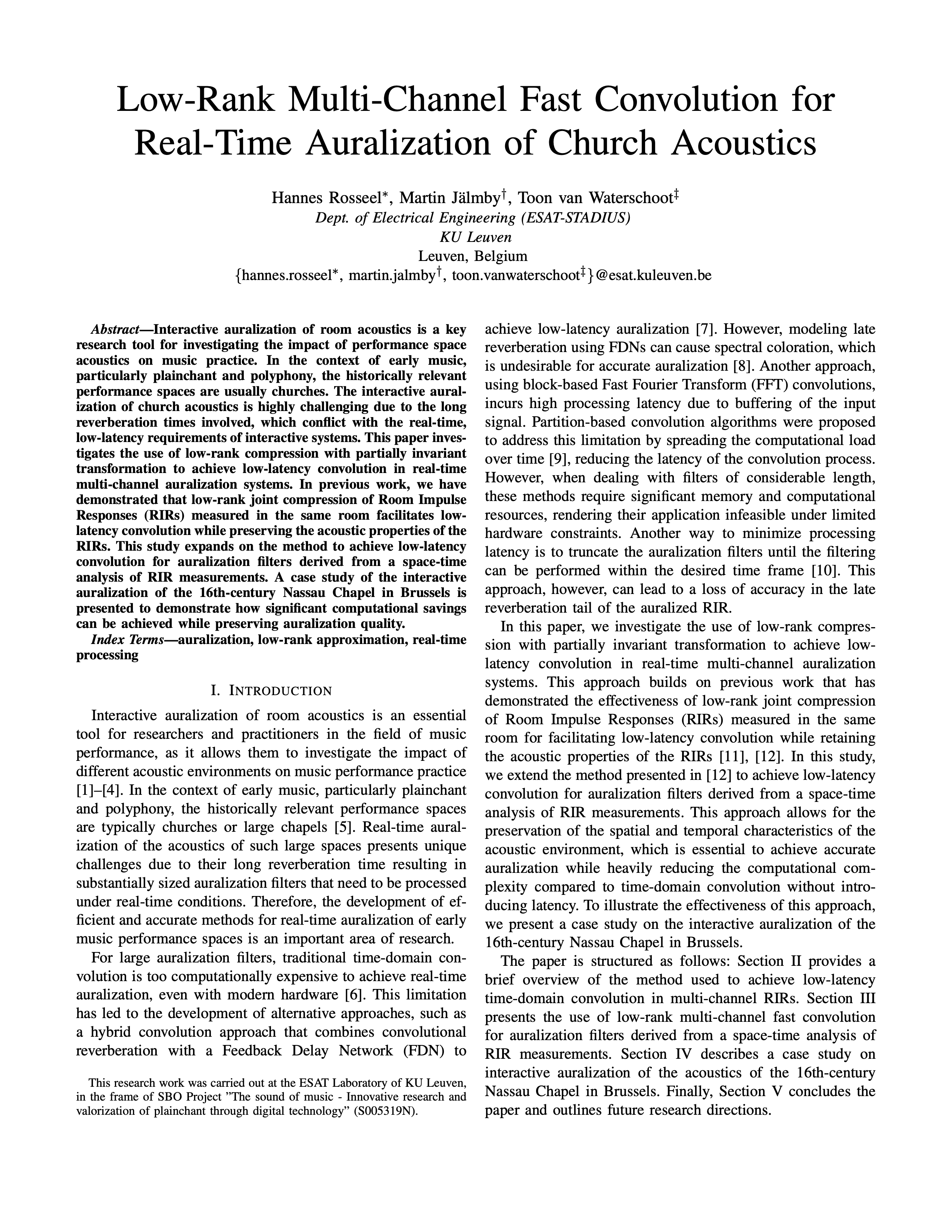
Low-Rank Multi-Channel Fast Convolution for Real-Time Auralization of Church Acoustics
Interactive auralization of room acoustics is a key research tool for investigating the impact of performance space acoustics on music practice. In the context of early music, particularly plainchant and polyphony, the historically relevant performance spaces are usually churches. The interactive auralization of church acoustics is highly challenging due to the long reverberation times involved, which conflict with the real-time, low-latency requirements of interactive systems. This paper investigates the use of low-rank compression with partially invariant transformation to achieve low-latency convolution in real-time multi-channel auralization systems. In previous work, we have demonstrated that low-rank joint compression of Room Impulse Responses (RIRs) measured in the same room facilitates low-latency convolution while preserving the acoustic properties of the RIRs. This study expands on the method to achieve low-latency convolution for auralization filters derived from a space-time analysis of RIR measurements. A case study of the interactive auralization of the 16th-century Nassau Chapel in Brussels is presented to demonstrate how significant computational savings can be achieved while preserving auralization quality.
@inproceedings{rosseel2024low,title={Low-Rank Multi-Channel Fast Convolution for Real-Time Auralization of Church Acoustics},author={Rosseel, Hannes and J\"{a}lmby, Martin and {van Waterschoot}, Toon},year={2024},booktitle={Proc. 32nd European Signal Processing Conference {(EUSIPCO 2024)}},pages={1017--1021},}
2023
conference
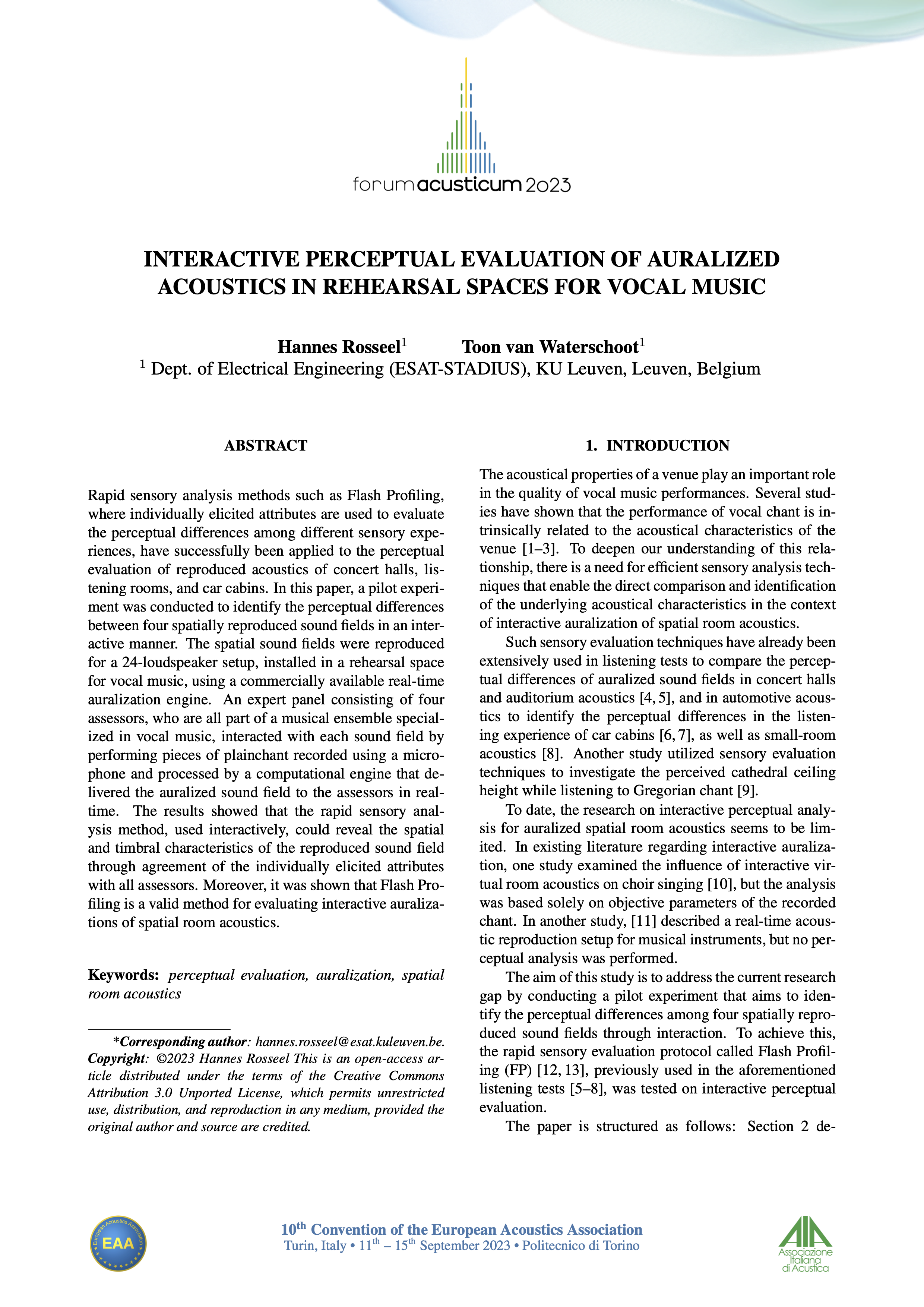
Interactive Perceptual Evaluation of Auralized Acoustics in Rehearsal Spaces for Vocal Music
Rapid sensory analysis methods such as Flash Profile, where individually elicited attributes are used to evaluate the perceptual differences among different sensory experiences, have successfully been applied to the perceptual evaluation of reproduced acoustics of concert halls, listening rooms, and car cabins. In this paper, a pilot experiment was conducted to identify the perceptual differences between four spatially reproduced sound fields in an interactive manner. The spatial sound fields were reproduced for a 24-loudspeaker setup, installed in a rehearsal space for vocal music, using a commercially available real-time auralization engine. An expert panel consisting of four assessors, who are all part of a musical ensemble specialized in vocal music, interacted with each sound field by performing pieces of plainchant recorded using a microphone and processed by a computational engine that delivered the auralized sound field to the assessors in realtime. The results showed that the rapid sensory analysis method, used interactively, could reveal the spatial and timbral characteristics of the reproduced sound field through agreement of the individually elicited attributes with all assessors. Moreover, it was shown that Flash Profile is a valid method for evaluating interactive auralizations of spatial room acoustics.
@inproceedings{rosseel2023interactive,title={Interactive Perceptual Evaluation of Auralized Acoustics in Rehearsal Spaces for Vocal Music},author={Rosseel, Hannes and {van Waterschoot}, Toon},year={2023},booktitle={Proc. Forum Acusticum 2023},pages={4123--4130},doi={10.61782/fa.2023.0745}}
2021
conference
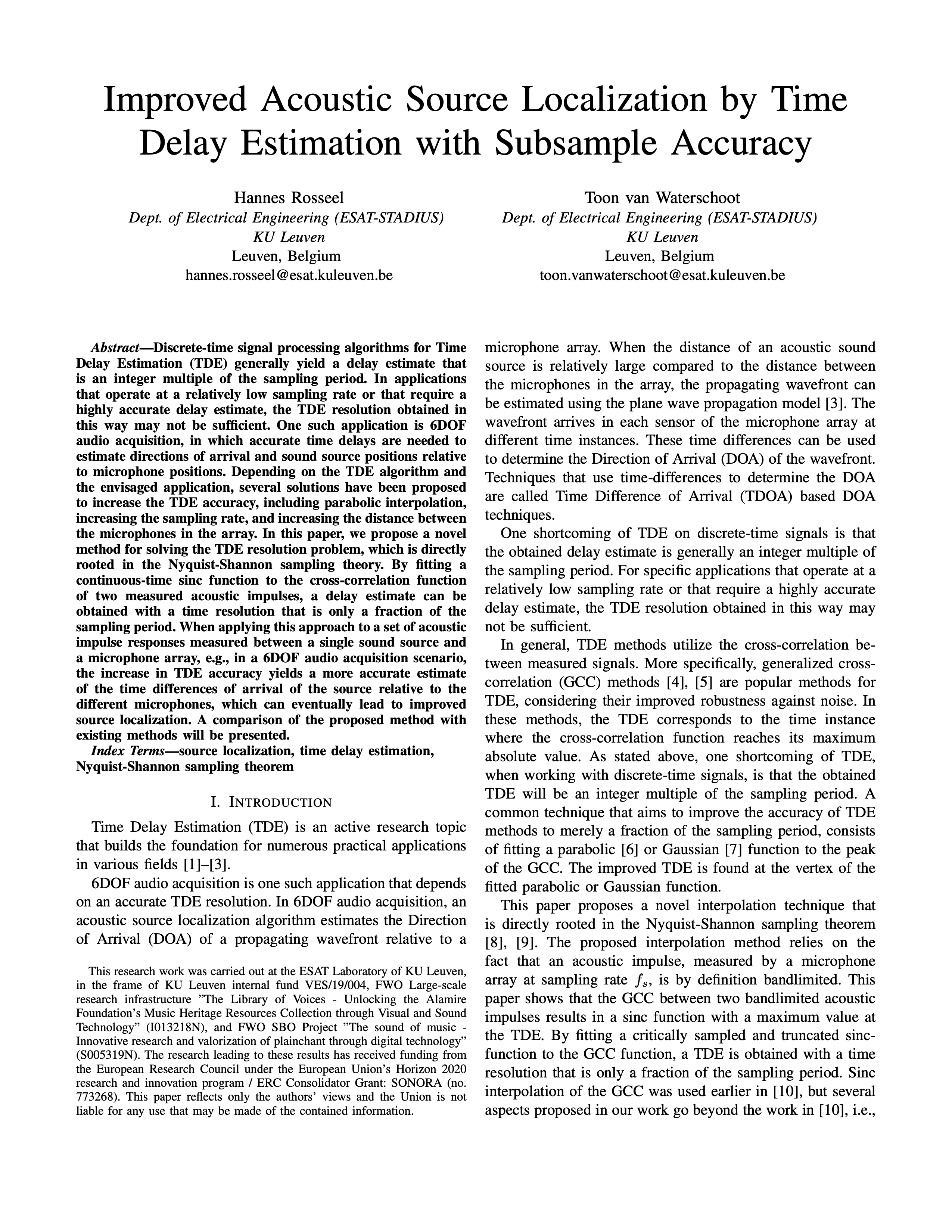
Improved Acoustic Source Localization by Time Delay Estimation with Subsample Accuracy
Discrete-time signal processing algorithms for Time Delay Estimation (TDE) generally yield a delay estimate that is an integer multiple of the sampling period. In applications that operate at a relatively low sampling rate or that require a highly accurate delay estimate, the TDE resolution obtained in this way may not be sufficient. One such application is 6DOF audio acquisition, in which accurate time delays are needed to estimate directions of arrival and sound source positions relative to microphone positions. Depending on the TDE algorithm and the envisaged application, several solutions have been proposed to increase the TDE accuracy, including parabolic interpolation, increasing the sampling rate, and increasing the distance between the microphones in the array. In this paper, we propose a novel method for solving the TDE resolution problem, which is directly rooted in the Nyquist-Shannon sampling theory. By fitting a continuous-time sinc function to the cross-correlation function of two measured acoustic impulses, a delay estimate can be obtained with a time resolution that is only a fraction of the sampling period. When applying this approach to a set of acoustic impulse responses measured between a single sound source and a microphone array, e.g., in a 6DOF audio acquisition scenario, the increase in TDE accuracy yields a more accurate estimate of the time differences of arrival of the source relative to the different microphones, which can eventually lead to improved source localization. A comparison of the proposed method with existing methods will be presented.
@inproceedings{rosseel2021improved,doi={10.1109/I3DA48870.2021.9610902},title={Improved Acoustic Source Localization by Time Delay Estimation with Subsample Accuracy},author={Rosseel, Hannes and {van Waterschoot}, Toon},year={2021},booktitle={Proc. 2021 Immersive and 3D Audio: from Architecture to Automotive (I3DA)},pages={1--8}}